
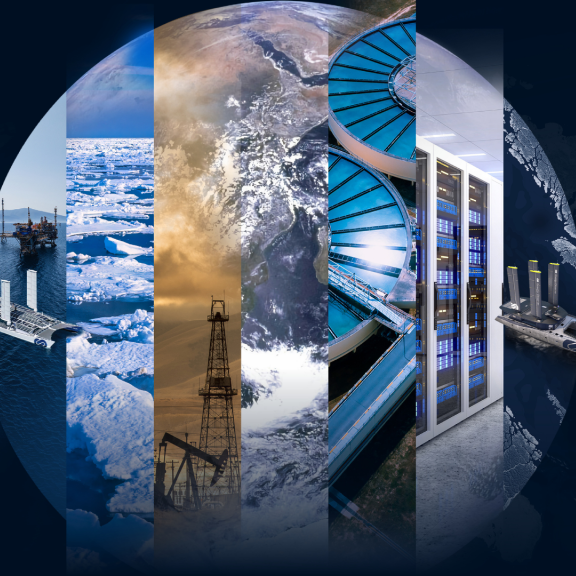
Unveiled during the United Nations Ocean Conference (UNOC3), this new expedition was launched by Mrs. Agnès Pannier-Runacher, Minister for Ecological Transition, Biodiversity, Forest, the Sea and Fisheries. On this occasion, she awarded Victorien Erussard, founder and president of Energy Observer, the Knight's medal of the French National Order of Merit.
This nine-year journey, structured around seven key missions, aims to explore tangible solutions to the major climate challenges of our time, with one common goal: identifying the keys to carbon neutrality. To carry out this ambitious global expedition and its initiatives to raise public awareness the challenges of the energy transition, Energy Observer can already count on the support of its first official partners, who fully share its vision, values, and goals: Accor, Delanchy Group, Qair, Natixis, Roullier Group, Toyota, and Chart Industries. These strategic collaborations provide essential financial, technical, and scientific support to meet the challenge of carbon neutrality and to develop the innovations that will shape the maritime mobility of tomorrow.
With this new expedition, Energy Observer begins a new chapter in its journey, focused on exploring concrete solutions to achieve carbon neutrality, while also addressing closely related issues such as biodiversity protection, ecosystem resilience and the adoption of circular models. The expedition will be structured around seven thematic missions, each exploring key levers to assess the feasibility of reaching carbon neutrality.
2025–2033: Seven missions to investigate the feasibility of carbon neutrality
This first mission will focus on analyzing carbon capture, storage, and utilization solutions for CO₂, the primary greenhouse gas responsible for climate change. Energy Observer will sail across Europe and the North Atlantic to study related industrial technologies, as well as natural ecosystems capable of long-term carbon sequestration.
This year will mark a major milestone with the launch of EO3, ten years after the first laboratory vessel, EO1, set sail. The mission, based in Europe, will be dedicated to the decarbonization of all forms of transportation: road, rail, maritime, and air
EO3 will circumnavigate Africa to explore the strategic role of critical metals in the energy transition. The mission will analyze their availability, the environmental and social impacts of extraction, and the global challenges of sovereignty and dependence they pose.
Along the North American coast, EO3 will investigate the role of artificial intelligence in the energy transition—assessing its potential to optimize energy systems and its net environmental benefit, considering its growing energy and material footprint.
Over the course of a two-year mission through the Middle East, Asia, and Oceania, EO3 will explore the coexistence of fossil fuels, renewables, and nuclear energy within diverse economic, climatic, and political contexts.
In South America and as far as the Antarctic Peninsula, this mission will focus on sustainable water management—an increasingly fragile vital resource under the strain of climate change. The mission will examine the tensions between availability, quality, energy use, and essential human needs.
To conclude this expedition, EO3 will undertake a polar world tour through the Arctic—an environmental sentinel of climate disruption and a stage for emerging geopolitical shifts. This mission will bring together experts from multiple disciplines to inform long-term adaptation and resilience strategies in the face of climate crises.
EO3: A Vessel to Illuminate Tomorrow’s Energy Choices
EO3, the proud successor to EO1, is a next-generation expedition catamaran that embodies the future of low-carbon shipping. In response to the International Maritime Organization’s target of a 70% reduction in greenhouse gas emissions by 2040, EO3 stands as a pioneering vessel designed to test and validate new decarbonized maritime solutions. Its innovative energy system combines multiple complementary sources:
- A low-carbon fuel: ammonia, an efficient hydrogen carrier
- Electric propulsion powered by batteries and both low- and high-temperature fuel cells
- Solar panels and four wing sails that contribute to propulsion and energy autonomy. EO3 is more than a vessel. It is a true innovation hub, designed to host multidisciplinary experts, engineering projects, audiovisual productions, and international events.
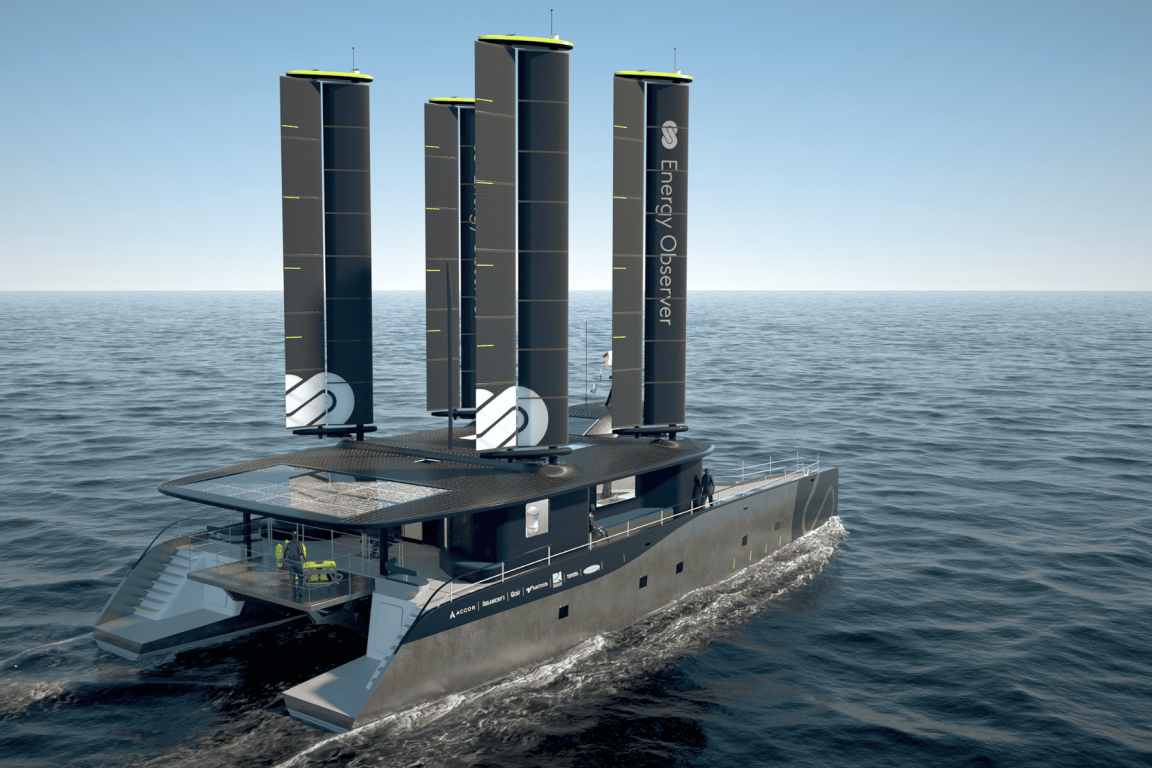
EO3 is above all a technological demonstrator. Its purpose is not to validate a single solution, but to assess, over time and at sea, several complementary energy architectures. Our goal is to deliver concrete, measurable data on the performance, robustness, and integration of these technologies. It is this experimental, rigorous approach that will help inform future industrial and regulatory decisions”

Didier BouixCEO of EO Concept